


Reagent-Free Drinking Water Treatment Station
reVODA is a high-tech solution for obtaining premium-quality drinking water from any surface water source: rivers and lakes.
Utilizing an advanced, innovative reagent-free technology, the station ensures deep water purification without the use of chemical agents, preserving its natural structure and completely eliminating secondary contamination.
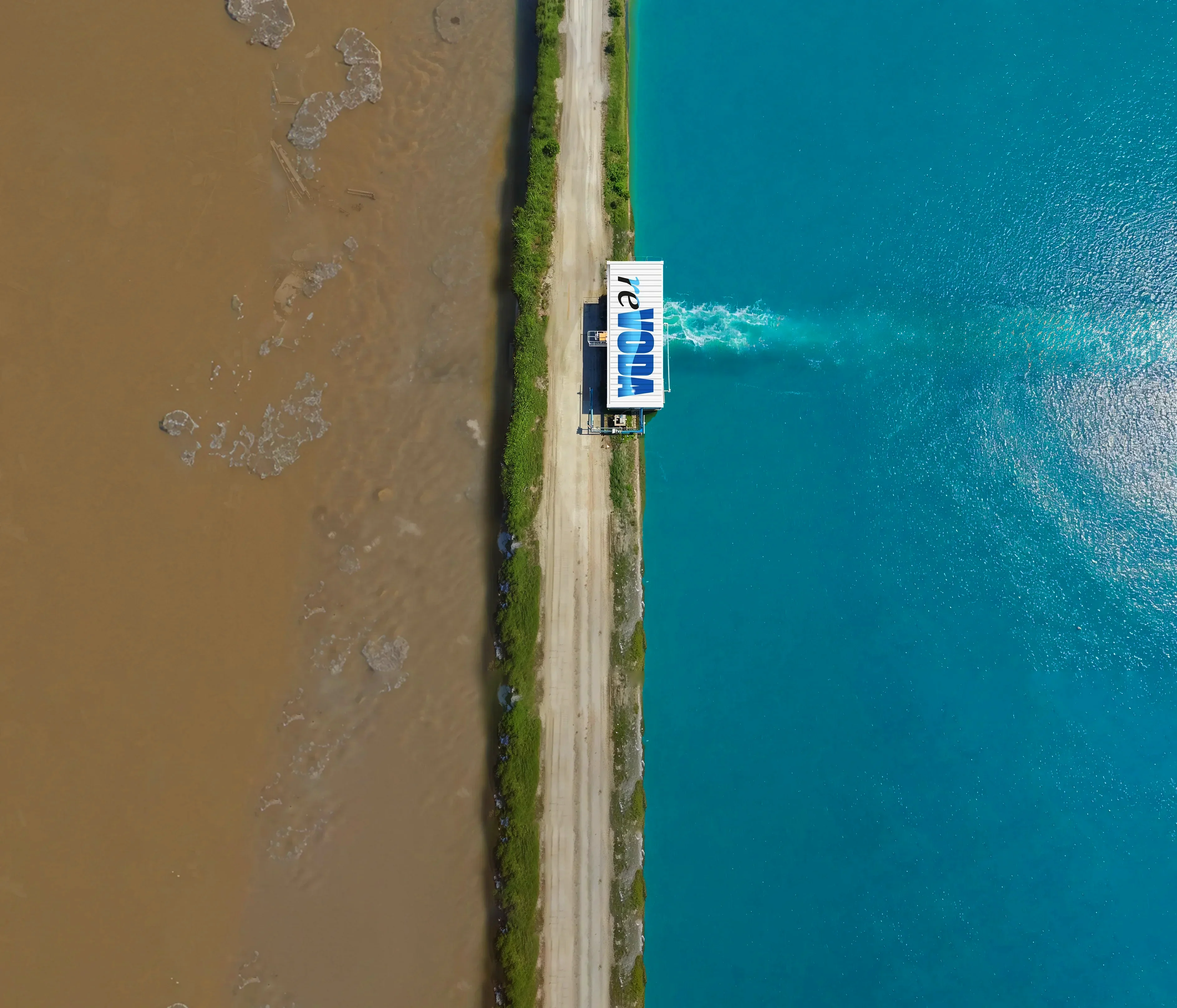
PROPERTIES AND QUALITY OF WATER IN RIVERS AND LAKES
Rivers and lakes are classified as surface water sources, and their water quality is characterized by several specific features:
- 1. Natural Variability of Composition: Water parameters (turbidity, salt content, temperature) are subject to significant seasonal and climatic fluctuations.
- 2. High Content of Impurities: A high concentration of suspended solids (sand, silt, clay) is typical, especially during flood periods.
- 3. Biological Activity: These sources are prone to "blooms"—the massive proliferation of microscopic algae. This degrades the organoleptic properties (taste, odor) and can impart allergenic characteristics.
- 4. Bacteriological Contamination: A high risk of the presence of pathogenic microorganisms.
- 5. Technogenic Impact: The presence of pollutants from industrial and municipal wastewater discharge, as well as from shipping activities.
STATION FOR REAGENT-FREE DRINKING WATER TREATMENT
reVODA is a high-tech solution for obtaining premium-quality drinking water from any surface water source: rivers and lakes.
Utilizing an advanced, innovative reagent-free technology, the station ensures deep water purification without the use of chemical agents, preserving its natural structure and completely eliminating secondary contamination.
FUNCTIONAL PURPOSE OF THE REVODA STATION
The reVODA station provides comprehensive water treatment, guaranteeing compliance with the most stringent sanitary norms and quality standards for both potable and industrial use. The equipment addresses the full spectrum of water purification challenges:
Chemical Analysis & Contaminant Removal
- Metal Removal: Absolute extraction of iron (including its difficult-to-oxidize forms), manganese, as well as toxic heavy metals (lead, mercury, cadmium, nickel, etc.).
- Demineralization & Softening: Effective reduction of total dissolved solids (TDS) and complete removal of hardness salts, preventing scale formation.
- Toxic Element Neutralization: Deep purification from arsenic, fluorine, boron, iodine, active chlorine, and their hazardous compounds.
- Organoleptics & Gases: Complete removal of dissolved gases (hydrogen sulfide), ammonia, and petroleum products that cause unpleasant odors and tastes.
Biological Safety (Sterilization)
- Microbiological Purification: 100% inactivation of all pathogenic bacteria and viruses, including the most resistant forms.
- Disinvasion: Guaranteed destruction of biological contaminants: helminth eggs, larvae, cysts, and vegetative forms of protozoan microorganisms (giardia, cryptosporidium, etc.).
Mechanical Filtration & Micro-particles
- Microplastics: Efficient removal of micro- and nanoplastic particles that pose a health risk.
- Suspended Solids: Water clarification by retaining sand, clay, rust, and other mechanical impurities.
Organoleptic Properties Correction
- Achieving Ideal Consumer Qualities: Complete elimination of turbidity, unpleasant tastes, and odors (from hydrogen sulfide, chlorine, petroleum products, mustiness).
- Restoration of natural water clarity, color, and freshness.
THE KEY ADVANTAGE OF THE REVODA STATION
The main difference of the reVODA technology from traditional filtration systems
- The ability not merely to trap, but to fully neutralize and eliminate contaminants that are non-removable by mechanical filtration.
The reVODA technology is a pioneering, innovative, reagent-free method
- An advance, chemical-free purification and neutralization method leveraging physico-chemical processes to yield ecologically pure water. It is identical to natural water, yet completely free from all anthropogenic and natural pollutants.
TECHNOLOGICAL ADVANTAGES OF THE REVODA STATION
Flexibility and Adaptability
- Scalable Capacity The modular design allows for solutions of any capacity, ranging from compact units (1 m³/hour) to industrial complexes ensuring water supply for entire enterprises or communities.
- Raw Water Versatility The equipment is undemanding regarding the source water's chemical composition, resistant to temperature fluctuations, and maintains efficiency during shock loads of pollutants or extended periods of inactivity.
Operation and Maintenance
- Adaptive Operation Mode The station operates equally effectively in a continuous 24/7 cycle as it does in an intermittent mode, as required by production needs. This allows for an optimized operational schedule tailored to specific tasks.
- Instant Start and Stop The equipment reaches operational mode immediately upon start-up and stops instantly when switched off. When not in operation, running costs are completely eliminated, and the station's equipment is not subject to wear.
- Energy Efficiency and Service:
- Specific energy consumption is only 1 kWh per 1 m³ of pure drinking water produced.
- Only one unskilled operator per shift is required for maintenance, minimizing payroll costs and personnel training expenses.
Environmental Friendliness and Safety
- Minimal Environmental Impact The station's sanitary protection zone is only 20 meters, allowing equipment placement in close proximity to residential areas and water intakes.
- Zero-Waste Production The sludge generated during the treatment process is completely neutral and safe (classified as non-hazardous waste). It can be disposed of in the general manner or used as organic fertilizer in agriculture and landscaping.
- Complete Absence of Chemicals The technology eliminates the use of hypochlorite, coagulants, flocculants, and corrosion inhibitors. This guarantees no secondary water pollution and no hazardous chemical discharges.
PURPOSE AND CONFIGURATIONS OF REVODA STATIONS
The station is ideally suited for both autonomous and centralized water supply systems where consistently high-water quality is required. Stations are available in two configurations: containerized and stationary.
MOBILE WATER TREATMENT STATIONS IN CONTAINERIZED CONFIGURATION
Key advantages include the ability for rapid deployment in any conditions without the need for permanent construction. This makes them highly sought-after in global niches where autonomy, speed, and reliability are critically important.
- Supporting remote camps and isolated facilities.
- Industry and agriculture in off-grid regions.
- Water supply stations for small settlements and eco-villages.
- Backup water supply for social infrastructure facilities.
- Disaster relief operations and humanitarian missions.
- Providing for major temporary events.
STATIONARY WATER TREATMENT PLANTS
Designed for long-term operation, high throughput, scalability, and seamless integration into the existing or planned infrastructure of residential communities, cities, and industrial facilities.
Municipal Water Supply and Utilities:
- City waterworks stations.
- Water treatment for boiler houses and thermal power plants.
- Industrial water recirculation systems.
Industrial Sector (B2B):
- Food and beverage industry.
- Pharmaceuticals and biotechnologies.
- Microelectronics.
- Chemical and petrochemical industries.
- Pulp and paper industry.
- Mining industry.
Power Generation:
- Nuclear and thermal power plants (NPPs, TPPs, GRES).
- Solar and geothermal energy.
Agriculture and Agro-Industrial Complex:
- Livestock farming complexes.
- Greenhouse facilities.
- Crop processing and storage.
Commercial Real Estate and Social Sector:
- Mixed-use complexes (MUC) and skyscrapers.
- Hotels and spa centers.
- Medical institutions (hospitals, laboratories).
- Educational and scientific research institutes.
BLOCK DIAGRAM AND DESCRIPTION OF STATION OPERATION
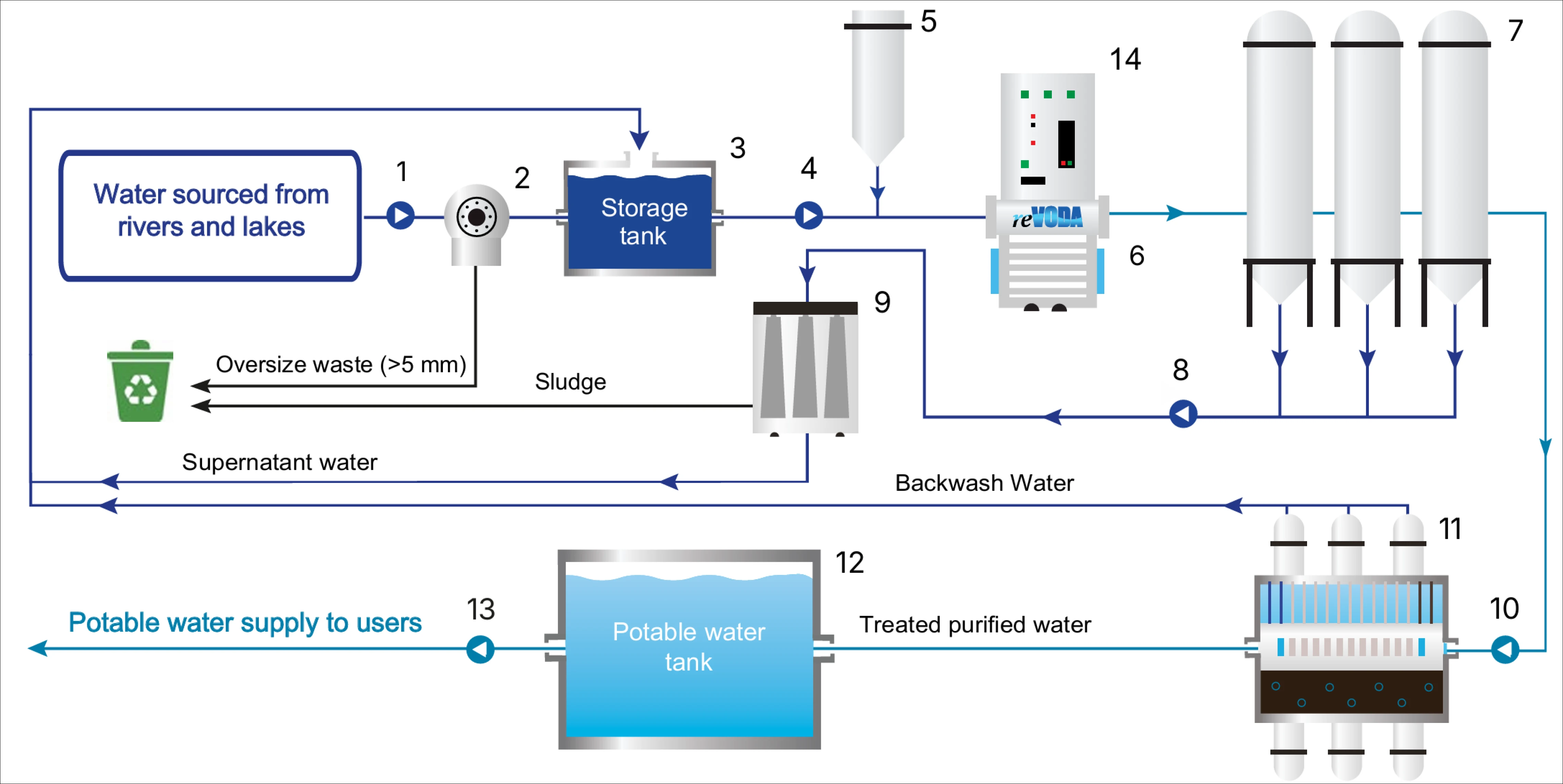
Water intake and preparation before feeding into the ReVODA Reactor
A self-priming pump (1) feeds water to a drum screen (2) which removes all debris larger than 5 mm. The screened water is then collected in a storage tank (3). From this tank, a centrifugal pump (4) delivers the water to the reVODA reactor (6). Immediately before the reactor, an ozonator with a concentrator (5) injects ozone and oxygen into the stream.
Water Treatment in the ReVODA Reactor
Inside the reVODA reactor, water is subjected to a powerful electromagnetic field, plasma, and cavitation. Within seconds, this initiates the processes of oxidation, water ionization, and the breakdown and removal of organic contaminants and pathogens, which subsequently settle as sludge.
Discharge of Neutralized Organic Sludge from the Water
The neutralized sludge settles at the bottom conical section of the settlers (7). From there, an impeller pump (8) transfers it to a bag filter (9) for dewatering. The neutralized sludge is sent for disposal, while the separated water is returned to the storage tank at the station inlet.
Final Water Polishing
The supernatant water from the settlers is fed by a centrifugal pump (10) to the final polishing stage (11), where any remaining suspended solids are removed
ReVODA Station Control System
The control panel (Instrumentation and Automation) (14) is designed to automate processes, provide continuous monitoring of all station systems, and ensure emergency protection against overloads.
Distribution of Treated Potable Water
From the storage tank (12), potable water is distributed to users via a pump station (13).
OPERATING PRINCIPLE OF THE REVODA REACTOR
Within the reactor of the reVODA station, a comprehensive physicochemical disinfection and deep purification of water from all types of contaminants (metals, salts, organic compounds, microplastics, and pathogens) takes place, bringing it up to high-quality drinking water standards.
THE REVODA REACTOR is a closed electromagnetic field reactor. As the treated water passes through the reactor's working zone, the closed field dramatically accelerates the rate of all separation processes at the water/sludge interface. The following chemical reactions and physical processes occur inside the reactor's working zone:
- Under the influence of a powerful rotating electromagnetic field within the reactor's working zone, water molecules are split into H⁺ and OH⁻ ions, which act as potent oxidizing agents.
- Simultaneously, charged ferrimagnetic needles are set into a three-dimensional rotation by the electromagnetic field. Their collisions generate spark discharges, forming plasma. This induces an electrolytic effect in the water and produces ozone—another powerful oxidizer—within the working zone.
- The implosion of air bubbles at the gas-liquid interface creates a cavitation shockwave with a force of 250 tons per square millimeter. This mechanically disintegrates all suspended organic matter in the water to a size of 20-40 angstroms.
- Through the combined action of cavitation and the presence of ozone, complete mechanical destruction of organic compounds and the eradication of all pathogenic microflora in the water is achieved.
- All of these chemical reactions, which would typically take place over a prolonged period in open air, are completed within one second in the reactor's working zone.
- При разрыве молекулы воды из всех органических веществ выводится связанная жидкость. В результате чего по выходу органики из рабочей зоны реактора, в седиментаторах под действием силы тяжести происходит разделение обработанного стока на шлам и надоса-дочную воду без коагулянта и флокулянта.
- All metal groups are converted into insoluble oxides and hydroxides, and are subsequently removed from the water along with the sludge.
THE REVODA REACTOR’S DESIGN allows for the parallel connection of one to four reactors in a single line within a 2.0 x 2.0 m area, providing a water purification and neutralization capacity of 1 to 60 m³ per hour.
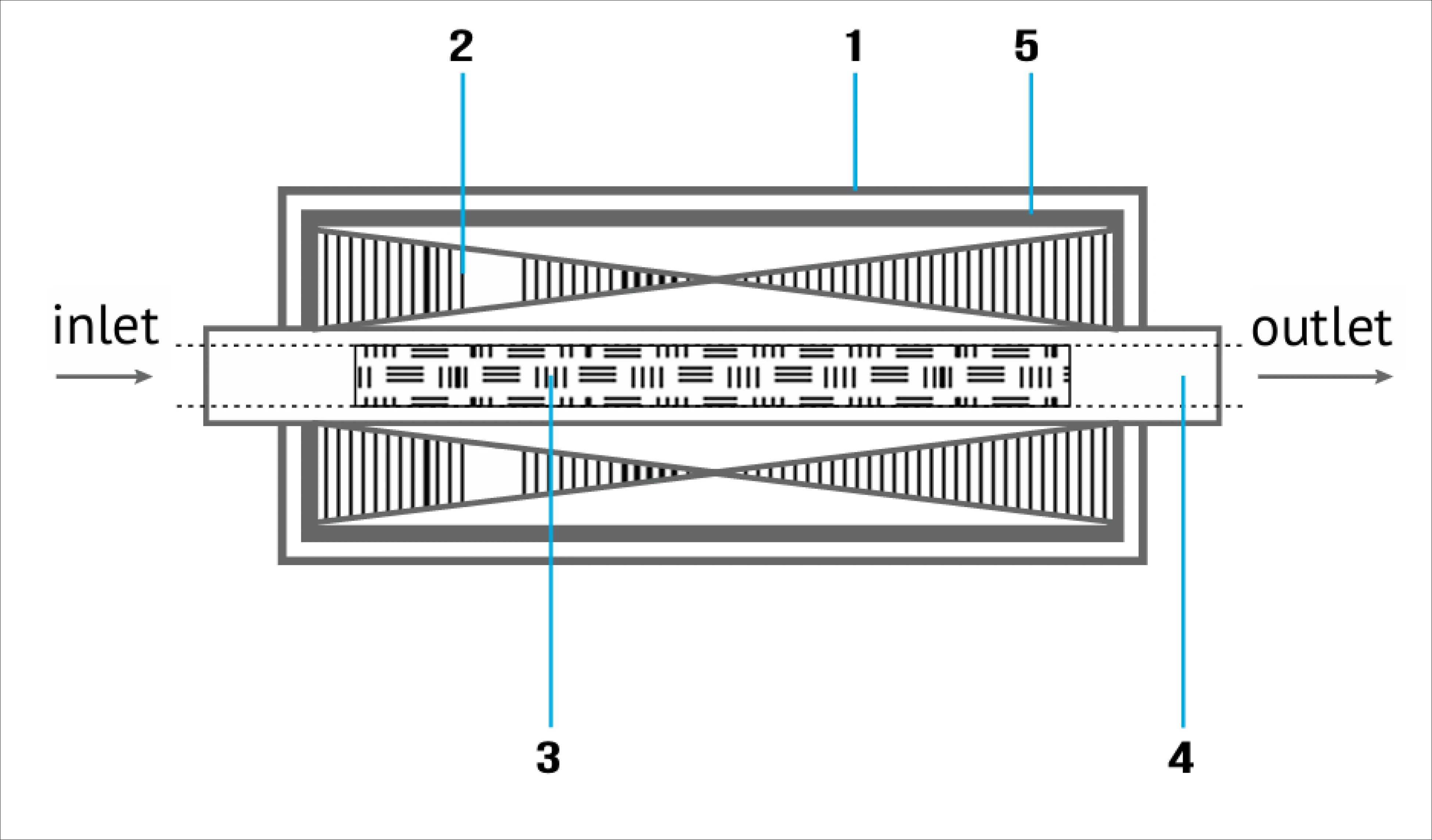
- 1. Housing
- 2. Inductor,
- 3. Ferromagnetic needles,
- 4. Replaceable insert
- 5. Working area of the device
REVODA MOBILE STATION BASED ON A 20-FOOT CONTAINER
TECHNICAL AND ECONOMIC INDICATORS OF THE STATION
- Water treatment level: Conforms to the WHO Guidelines for Drinking-water Quality (GDWQ)
- Capacity of the reVODA Station:
- Hourly: 10 m³/hour
- Daily:230 m³/day
- Operating mode of the reVODA Station:
- Intermittent (flexible schedule):As required
- Continuous round-the-clock:24/7
- Peak power consumption of the reVODA Station:19.9 kWh
- Weight of the reVODA Station:
- Dry weight - container and equipment without water filling:2 900 kg
- Operating weight in working condition: 6 100 kg
- Service life of the reVODA Station (at least):15 years
REVODA MOBILE STATION BASED ON A 40-FOOT CONTAINER
TECHNICAL AND ECONOMIC INDICATORS OF THE STATION
- Water treatment level: Conforms to the WHO Guidelines for Drinking-water Quality (GDWQ)
- Capacity of the reVODA Station:
- Hourly: 30 m³/hour
- Daily:700 m³/day
- Operating mode of the reVODA Station:
- Intermittent (flexible schedule):As required
- Continuous round-the-clock:24/7
- Peak power consumption of the reVODA Station:42.8 kWh
- Weight of the reVODA Station:
- Dry weight - container and equipment without water filling:4 700 kg
- Operating weight in working condition: 13 900 kg
- Service life of the reVODA Station (at least):15 years
Lead time for a turnkey reVODA Station
- 4 to 6 months.
Warranty period for the reVODA Station
- 24 months.
Spare parts for the warranty period
- The scope of supply for the reVODA Station includes spare parts for 24 months of operation.
Certification of reVODA Station Equipment
- The reVODA Station is supplied with all required certificates, technical specifications, and expert approvals. To view and/or download the documents, please use the link
PROVEN RELIABILITY OVER TIME
- reVODA RF-DWTS (Reagent-free Drinking Water Treatment Station) and reVODA WWTP (Wastewater Treatment Plant) compact units boast 15 years of successful operation in the field. During this time, they have demonstrated absolute resilience in aggressive environments—with zero failures or malfunctions attributed to design or manufacturing defects.
Contacts
Contact us - we are available 24/7.

Viktor Uzlov
Commercial Director
 Phone
Phone
 Email
Email